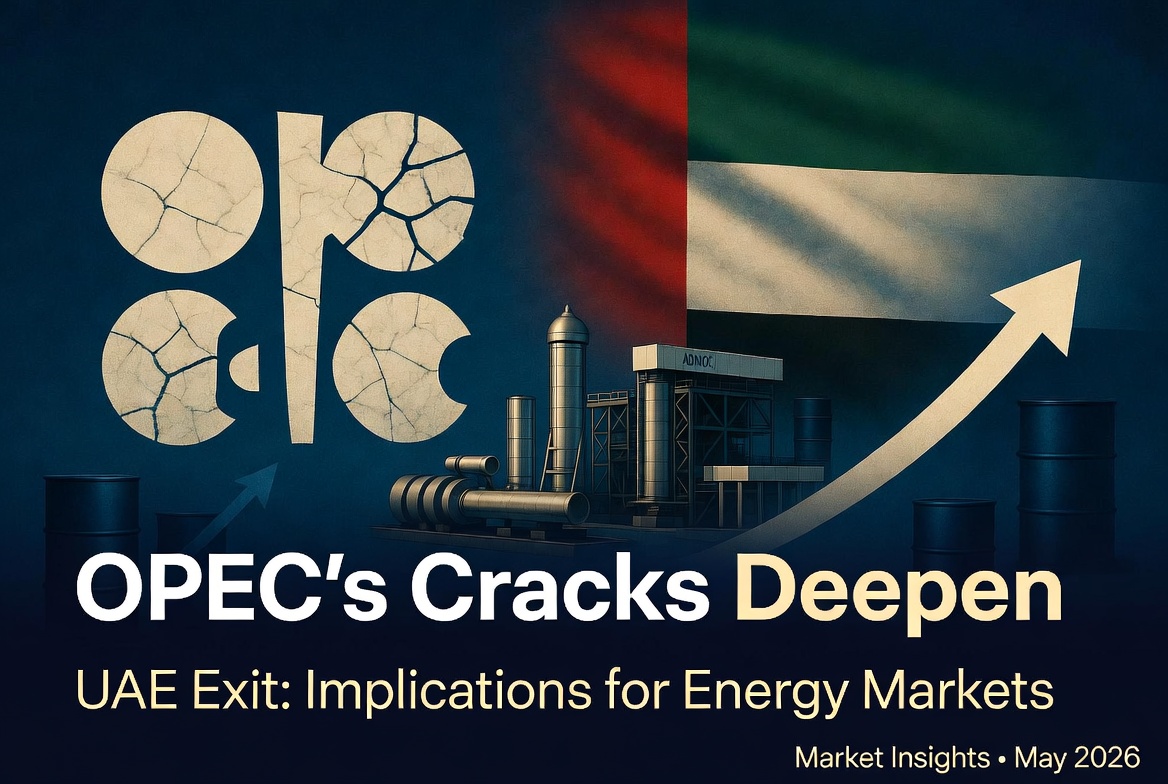
OPEC’s Cracks Deepen UAE Exits
OPEC’s Cracks Deepen : Lessons from Angola and the UAE Exits
By the Achiever Financials Ltd Analysis Team May 14, 2026
The Organization of the Petroleum Exporting Countries (OPEC) is facing its most significant challenge to cohesion in recent years. Within just over two years, two notable members — Angola and the United Arab Emirates — have chosen to exit the cartel, highlighting growing tensions between collective production discipline and individual national economic priorities.
As independent analysts at Achiever Financials Ltd, we examine the drivers behind these departures, their market implications, and what they mean for energy investors in 2026 and beyond.
Angola’s Exit: A Producer in Decline Prioritizes Flexibility (January 2024)
Angola, which joined OPEC in 2007, officially left the organization effective 1 January 2024. The decision followed months of disputes over production quotas. In late 2023, OPEC+ auditors revised Angola’s 2024 baseline downward to approximately 1.11 million barrels per day (bpd), below the level the country believed it could sustainably achieve.
Key Reasons for Exit:
- Maturing oil fields and structural production decline.
- Need to attract fresh international investment into upstream projects.
- Desire for output flexibility to maximise near-term revenue as oil remains the backbone of government finances.
Post-exit, Angola has pursued greater autonomy, focusing on new licensing rounds and natural gas development. While the move has not reversed the long-term decline in output overnight, it has improved policy signalling to international oil companies (IOCs) and supported broader economic diversification efforts under President João Lourenço.
From a market perspective, Angola’s exit had limited immediate supply impact due to its modest share of global production. However, it served as an early warning sign of eroding cartel discipline among smaller or challenged producers.
UAE Exit: A High-Capacity Giant Seeks Unconstrained Growth (May 2026)
On 28 April 2026, the UAE announced its decision to leave both OPEC and the wider OPEC+ alliance, effective 1 May 2026. This departure represents a far more substantial blow to the group than Angola’s exit.
The UAE, an OPEC member since 1967 and one of the world’s lowest-cost producers through ADNOC, has aggressively expanded its production capacity. With ambitions to reach around 5 million bpd by 2027, the country repeatedly clashed with quota allocations that constrained its ability to produce at fuller potential.
Primary Drivers:
- Frustration with production caps amid heavy upstream investment.
- Strategic economic diversification (Vision 2031) that benefits from maximizing hydrocarbon revenues during the transition period.
- Diverging priorities within the Gulf: preference for volume over rigid price-supporting cuts.
The UAE’s exit is particularly notable because it is a core, high-capacity Gulf producer — unlike previous departures such as Qatar (2019) or Ecuador.
Comparative Analysis: Two Exits, Different Contexts
| Aspect | Angola (2024) | UAE (2026) |
|---|---|---|
| Production Trend | Declining | Expanding |
| Main Motivation | Survival & investment attraction | Growth maximization |
| Quota Conflict | Quotas seen as too low | Quotas seen as too restrictive |
| Market Impact | Modest | Potentially significant |
| Strategic Implication | Signal of weakness in smaller members | Challenge to Gulf unity & cartel power |
Both cases underscore a fundamental reality: OPEC+ quotas work best when they align with members’ long-term interests. When they diverge — whether due to declining fields (Angola) or ambitious capacity growth (UAE) — national priorities prevail.
Market and Investment Implications
- Oil Price Pressure: Increased autonomy for major producers like the UAE could add supply to the market at a time when global demand faces questions around economic growth, energy transition, and efficiency gains. This dynamic generally favors consumers and import-dependent economies but adds volatility for producers.
- OPEC+ Cohesion: With successive exits, the burden of production management increasingly falls on a smaller core (led by Saudi Arabia). This may lead to either more aggressive cuts by remaining members or a gradual erosion of the group’s market influence.
- Investment Opportunities:
- Upstream in Exiting Countries: Potential for renewed IOC interest in Angola and sustained investment flows into the UAE.
- Diversified Energy Plays: Companies with exposure to flexible, low-cost production or non-OPEC supply (including U.S. shale) may benefit from a less constrained supply environment.
- Risk Premium: Geopolitical and cartel-related volatility remains a key factor in energy pricing models.
- Longer-Term Outlook: These exits reflect a maturing global oil market where traditional cartel power faces limits from shale flexibility, renewables growth, and differing member economics.
Final Thoughts from Achiever Financials Ltd
The departures of Angola and the UAE illustrate that OPEC membership is not sacrosanct when it conflicts with core national economic objectives. For investors, this evolving landscape reinforces the importance of diversification across energy sub-sectors and careful monitoring of production policy signals from both OPEC+ and non-OPEC players.
At Achiever Financials Ltd, we continue to track these developments closely. While near-term oil market volatility may rise, strategic opportunities exist for those positioned across the full energy value chain.
Disclaimer: This analysis is for informational purposes only and does not constitute investment advice. Past performance is not indicative of future results.