FOMC March 2026
FOMC Policy Update & Analysis March 2026
By the Achiever Financials Ltd Analysis Team March 19, 2026
Yesterday’s FOMC Meeting (March 17-18, 2026): Rates Held Steady Amid Geopolitical Risks, Tariff-Driven Inflation, and a Cautious Outlook
Executive Summary
The Federal Open Market Committee (FOMC) concluded its two-day March meeting on Wednesday, March 18, 2026, by unanimously maintaining the target range for the federal funds rate at 3½ to 3¾ percent — the second consecutive hold following the 75 basis-point easing cycle that concluded in December 2025. One dissenter (Governor Stephen I. Miran) favoured an immediate 25bp cut, but the majority signalled patience.
The accompanying Summary of Economic Projections (SEP) showed modestly stronger growth forecasts but higher near-term inflation readings, with the median policy-rate path unchanged at 3.4% by end-2026 (implying roughly one 25bp cut later this year). Chair Jerome Powell stressed elevated uncertainty stemming from Middle-East supply disruptions and recent tariff effects, describing the current stance as “appropriate” while keeping all options open.
Markets reacted with a risk-off tone: major U.S. equity indices closed 1.4–1.6% lower, oil prices extended gains, and the dollar strengthened on safe-haven flows. Precious metals came under notable pressure from the stronger USD and rising real yields, despite ongoing geopolitical support.
Key Policy Decision
- Federal Funds Rate: Unchanged at 3.50–3.75%.
- Vote: 11–1 (Miran dissented in favour of a ¼-point cut).
- Forward Guidance: The Committee will “carefully assess incoming data, the evolving outlook, and the balance of risks” and stands ready to adjust policy “as appropriate” if risks to the dual mandate materialise.
The statement language was little changed from January, but added explicit reference to “developments in the Middle East” and noted that “uncertainty about the economic outlook remains elevated.”
Economic Assessment from the Statement Available indicators point to solid economic expansion: resilient consumer spending, expanding business fixed investment, and a still-weak housing sector. Labour market remains balanced with unemployment steady at 4.4%. Inflation is “somewhat elevated” at 2.8% headline and 3.0% core PCE, lifted by tariffs and energy prices.
Summary of Economic Projections (SEP) & Dot-Plot Highlights Median projections (vs. December):
- Real GDP growth: 2.4% in 2026 (↑)
- Unemployment: 4.4% end-2026 (unchanged)
- Total PCE inflation: 2.7% in 2026 (↑)
- Median federal funds rate: 3.4% end-2026 (unchanged path)
The dot plot continues to embed approximately one 25bp cut in 2026, with the distribution shifting slightly hawkish.
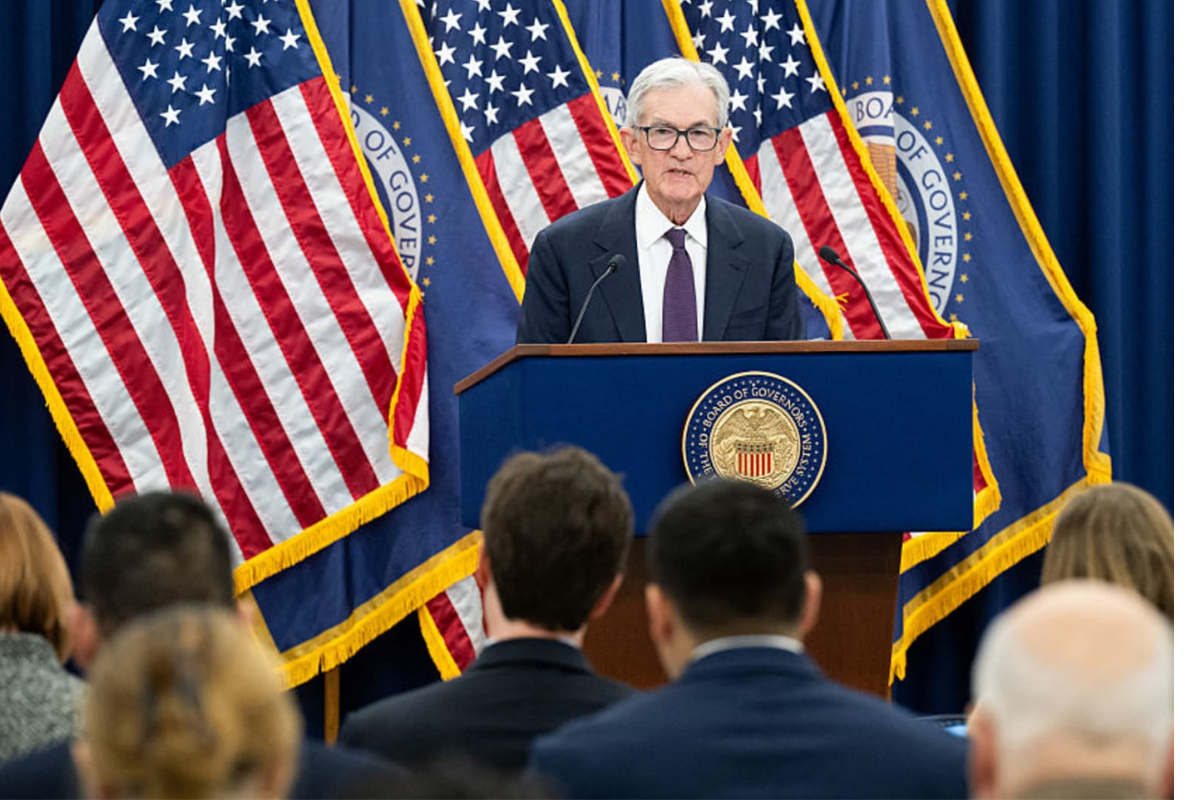
Chair Powell’s Press Conference Takeaways Powell highlighted solid growth, geopolitical uncertainty from Middle-East oil disruptions, visible tariff effects on goods prices, and a policy stance now “within a range of plausible estimates of neutral.” He gave no timetable for cuts, reinforcing a data-dependent, meeting-by-meeting approach.
Market Reaction (Intraday & Closing)
- Equities: Dow Jones –1.6%, S&P 500 –1.4%, Nasdaq –1.5%.
- Oil: Extended rally on Middle-East supply concerns.
- Treasuries: Yields edged higher; 10-year note rose 4bps.
- Currencies: The U.S. Dollar Index (DXY) rose approximately 0.5% to close near 100.09–100.17 — reflecting renewed strength on reduced rate-cut expectations and safe-haven flows amid geopolitical tensions. EUR/USD and GBP/USD weakened modestly (0.4–0.6%), while USD/JPY climbed. Emerging-market currencies faced broad pressure against the USD.
- Gold: Spot gold declined sharply, closing around $4,820–$4,885 per ounce (down roughly 2–3% on the day). While Middle-East risks initially provided some support, the stronger USD, rising real yields, and hawkish Fed tone dominated, pushing prices lower after recent record highs above $5,000–$5,400 earlier in 2026. Intraday volatility was elevated as gold tested key support levels.
- Silver: Underperformed gold, falling around 3–6% to settle near $71–$77 per ounce (exact closes varied by source between $71.15–$76.85). The higher-beta industrial component amplified the move amid cautious growth signals and profit-taking after recent surges toward $80–$100; the gold/silver ratio widened notably.
Volatility spiked briefly around the 2:00 p.m. EDT statement release but remained orderly, consistent with the meeting largely meeting consensus expectations.
Investment Implications – Achiever Financials Ltd View
- Fixed Income: Front-end preference; cautious on duration given upward yield pressure.
- Equities: Defensive sectors and quality dividend payers favoured; energy names may benefit from oil strength.
- Precious Metals: Gold retains its long-term hedging value against geopolitical shocks and inflation risks but faces near-term headwinds from USD strength and real yields. Tactical longs may be trimmed or re-entered on dips toward major support. Silver’s sharper decline highlights its volatility — suitable only for aggressive portfolios with strict risk management.
- Currencies & Commodities: USD strength expected to persist while Middle-East risks and hawkish Fed bias remain. Favour selective long-USD positions vs. EUR/GBP; use EM currency hedges where appropriate.
- Portfolio Positioning: Neutral-to-cautious equity exposure. Increase cash/short-duration buffers. Monitor upcoming CPI, employment data, and any escalation in geopolitical tensions for the next directional cue.
Outlook for the Rest of 2026 With only one cut now priced for 2026 and inflation risks tilted upward, the “higher-for-longer” regime is likely to extend. The June SEP update will be pivotal. At Achiever Financials Ltd we continue to stress-test portfolios against 0–2 cuts this year and stand ready to adjust allocations accordingly.
Disclaimer: This analysis is for informational purposes only and does not constitute investment advice. Past performance is not indicative of future results.