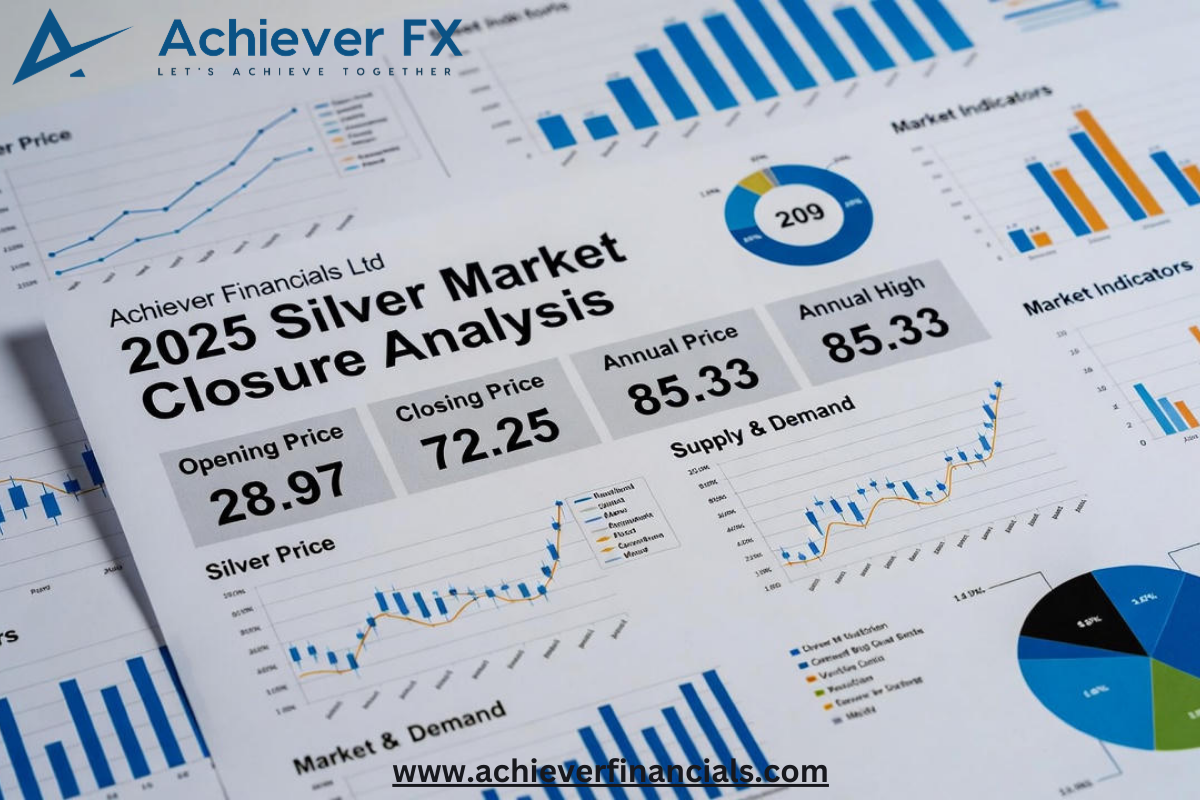
Silver Market 2025 Closure Analysis
Silver (XAG/USD) 2025 Closure Analysis.!
By Achiever Financials Ltd
Executive Summary :-
The year 2025 marked an extraordinary period for silver, characterized by unprecedented price volatility and substantial gains driven by persistent supply deficits, surging industrial demand, and macroeconomic influences. Silver prices more than doubled over the course of the year, outperforming gold and emerging as one of the top-performing commodities. Starting the year at approximately $28.87 per ounce, silver closed at $72.30 per ounce, reflecting a staggering annual gain of over 150%. This performance was fueled by structural market imbalances, with global silver demand outstripping supply for the fifth consecutive year, leading to a projected deficit exceeding 200 million ounces.
Key highlights include a peak price of $85.33 per ounce and a low of $28.37 per ounce, amid influences from industrial sectors like solar photovoltaics (PV), electric vehicles (EVs), and data centers. While recent market corrections introduced short-term declines—such as an 8.7% drop in late December—silver’s resilience underscores its dual role as both an industrial metal and a safe-haven asset. This report provides a comprehensive review of silver’s 2025 performance, analysing price trends, supply-demand dynamics, and influencing factors, as prepared by Achiever Financials Ltd.
Price Trends and Performance Metrics :-
Silver’s price trajectory in 2025 was nothing short of dramatic, with the metal achieving its strongest yearly performance on record. The spot price (XAG/USD) opened the year at $28.87 per ounce and surged to a high of $85.33 per ounce before settling at $72.30 per ounce by year-end. This represents a year-over-year increase of approximately 150%, significantly outpacing gold’s 59% gain and highlighting silver’s volatility and upside potential.
The rally was not linear; early-year stability gave way to sharp ascents in the second half, driven by supply constraints and demand spikes. Monthly average prices escalated from around $30.30 in January to $65.82 in December, reflecting accelerating momentum. Recent sessions saw a pullback, with silver declining 5.15% on December 31 amid broader market retreats, but the overall trend remained bullish.
For context, silver hit record highs multiple times, including $83.62 per ounce in late December, before a sharp sell-off attributed to profit-taking and equity market pressures. Despite this, the metal rebounded quickly, signalling ongoing investor optimism.
The following table summarises key price metrics for 2025:
| Metric | Value (USD per ounce) |
|---|---|
| Opening Price | 28.87 |
| Closing Price | 72.30 |
| Annual High | 85.33 |
| Annual Low | 28.37 |
| Year-over-Year Gain | +150% |
To visualize the year’s progression, below is a depicting monthly average closing prices:
| Month | Monthly Average Silver Price (USD) |
| 2025-01 | 30.29 |
| 2025-02 | 32.06 |
| 2025-03 | 33.18 |
| 2025-04 | 32.08 |
| 2025-05 | 32.77 |
| 2025-06 | 35.94 |
| 2025-07 | 37.72 |
| 2025-08 | 38.19 |
| 2025-09 | 42.75 |
| 2025-10 | 49.39 |
| 2025-11 | 50.86 |
| 2025-12 | 65.82 |
Key Factors Driving Silvers’s Performance :-
Silver’s remarkable ascent in 2025 was propelled by a confluence of industrial, economic, and geopolitical factors. Unlike gold, which is primarily a monetary asset, silver’s price is heavily influenced by its industrial applications, accounting for over 50% of demand. Here are the primary drivers:
- Industrial Demand Surge: Robust consumption from sectors like solar PV, EVs, and electronics was a dominant force. Silver’s conductivity made it indispensable for solar panels, where demand peaked amid global renewable energy pushes. Data centers and AI infrastructure also boosted usage, with industrial demand projected to remain high despite a slight 2% dip due to economic uncertainty. Additionally, India’s festival season (e.g., Diwali) and U.S. imports spiked physical demand early in the year.
- Supply Constraints and Deficits: Global silver supply failed to keep pace, leading to a structural deficit estimated at 115-265 million ounces—the fifth successive year of shortfalls. Mining output rose modestly by 2%, but recycling and above-ground stocks couldn’t bridge the gap. Factors like labor costs, energy prices, and consumables further elevated production expenses.
- Macroeconomic and Geopolitical Influences: Lower interest rates and inflation expectations supported precious metals, with silver benefiting from its correlation to gold (which rose 59%). Geopolitical tensions, including trade wars and “metals wars,” amplified safe-haven buying. Elon Musk’s warnings about silver’s impact on manufacturing highlighted supply chain vulnerabilities.
- Investment and Speculative Flows: Retail and institutional investors piled in, with 57% of surveyed retail investors expecting prices above $100 per ounce in 2026. This speculative enthusiasm contributed to volatility, including blow-off risks and sharp corrections, but underpinned the overall rally.
These elements created a perfect storm, propelling silver to decade-highs by September ($44.86) and beyond.
Supply and Demand Dynamics:-
Global silver demand in 2025 totaled approximately 1.12 billion ounces, a 4% decline year-over-year due to economic slowdowns, yet still robust enough to sustain deficits. Industrial applications dominated at around 60-65% of demand, with solar PV alone consuming record volumes amid clean energy transitions. Investment demand, including physical bars, coins, and ETFs, surged mid-year, while jewellery and silverware saw moderate growth in emerging markets like India.
On the supply side, total output (mine production plus recycling) increased modestly to about 1 billion ounces, up 2% from 2024, but fell short of demand by a wide margin. Primary silver mines faced cost pressures from labor, energy, and cyanide prices, limiting expansions. Recycling rates improved but were insufficient to offset the gap, exacerbating tightness.
The resulting deficit—projected at 200-265 million ounces—drew down inventories, pushing prices higher and signaling ongoing market stress. This imbalance is expected to persist into 2026, though potential demand softening in manufacturing could moderate it.
Conclusion and Outlook for 2026 :-
In 2025, silver solidified its position as a high-beta asset in the commodities space, delivering exceptional returns amid supply shortages and insatiable industrial appetite. Achiever Financials Ltd. views this year as a pivotal shift, where silver’s industrial utility overshadowed its traditional monetary role, leading to a 150% rally and record highs. While volatility remains a risk—as evidenced by late-year sell-offs—the fundamentals of tight supply and diverse demand sources position silver favourably for continued strength.
Investors should monitor industrial trends, particularly in renewables and technology, alongside macroeconomic indicators. Achiever Financials Ltd. recommends diversified exposure to silver as part of a balanced portfolio, given its proven resilience in uncertain times.
Disclaimer: This analysis is for informational purposes only and does not constitute investment advice. Past performance is not indicative of future results. Trading commodities involves substantial risk of loss.
Regards
Achiever Financials Ltd