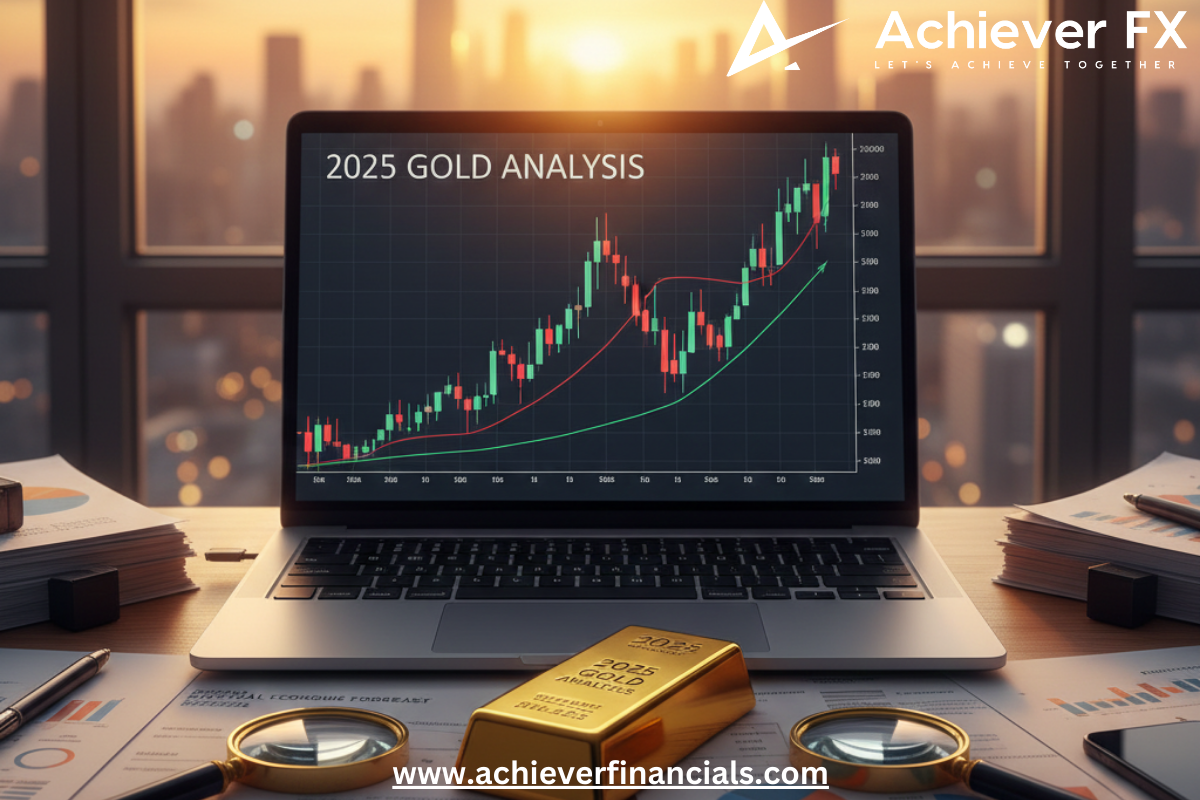
Gold Market 2025 Closure Analysis
Gold (XAU/USD) 2025 Closure Analysis.!
By Achiever Financials Ltd
Executive Summary :-
As we close the books on 2025, gold has emerged as one of the standout performers in global financial markets, delivering exceptional returns amid a backdrop of economic uncertainty, geopolitical tensions, and shifting monetary policies. This report provides a comprehensive review of gold’s price dynamics, key drivers, and broader implications for investors. At Achiever Financials Ltd., we view gold’s remarkable year as a testament to its enduring role as a safe-haven asset, with implications extending into portfolio strategies for 2026 and beyond.
Gold prices surged approximately 70% over the course of 2025, marking the strongest annual gain since 1979. Starting the year around $2,630 per troy ounce, the metal climbed steadily, surpassing $4,000 in October and peaking at an all-time high of $4,549.98 in December before settling at $4,461.50 on December 29. This performance far outpaced major equity indices, with the S&P 500 gaining far less in comparison, highlighting gold’s decoupling from traditional risk assets.
Price Trends and Performance Metrics :-
Gold’s ascent in 2025 was characterized by over 50 all-time highs, reflecting sustained bullish momentum. The year began with modest gains, building on momentum from late 2024, before accelerating in the spring amid expectations of Federal Reserve rate cuts. By mid-year, prices had established a new floor around $3,000, up from the previous $2,000 benchmark. The second half saw even sharper rallies, driven by institutional inflows and global events, culminating in a year-end close that represented a 70% increase.
Key metrics for 2025:
- Starting Price: ~$2,630 (January open)
- Ending Price: $4,461.50 (December 29 close)
- Yearly High: $4,549.98
- Yearly Low: ~$2,600 (early January)
- Percentage Change: +70%
- Volatility: Moderate, with pullbacks limited to 5-10% amid overall uptrend
To visualize this trajectory, the following illustrates monthly closing prices, showcasing the consistent upward trend.
| Month (2025) | Gold Price (USD/oz) |
| Jan | 2630 |
| Feb | 2750 |
| Mar | 3000 |
| Apr | 3200 |
| May | 3400 |
| Jun | 3600 |
| Jul | 3800 |
| Aug | 3950 |
| Sep | 4100 |
| Oct | 4250 |
| Nov | 4400 |
| Dec | 4462 |
Key Factors Driving Gold’s Performance :-
Several interconnected factors propelled gold’s historic rally in 2025, transforming it from a defensive asset into a core portfolio component.
- Monetary Policy Shifts: The Federal Reserve’s rate-cutting cycle, initiated in response to cooling inflation and economic slowdown signals, weakened the U.S. dollar and boosted gold’s appeal. Lower interest rates reduced the opportunity cost of holding non-yielding assets like gold, fueling a surge in demand.
- Geopolitical Tensions: Escalating conflicts, including hotspots in Venezuela and broader trade concerns, amplified gold’s safe-haven status. Events such as heightened U.S.-China trade disputes and regional instabilities in the Middle East prompted investors to seek refuge in precious metals.
- Central Bank Purchases: Global central banks accumulated record volumes, with over 634 tonnes added in the first nine months alone. This structural demand, part of a broader de-dollarization trend, provided a firm price floor and signaled long-term confidence in gold as a reserve asset.
- Institutional and ETF Inflows: Gold ETFs saw unprecedented net inflows of $85 billion year-to-date, more than double the 2020 record. This rotation from equities, amid concerns over AI-driven stock bubbles and overvaluation, further propelled prices.
- Inflation and Economic Uncertainty: Persistent inflation above 3% in key economies, coupled with $324 trillion in global debt, heightened fears of currency debasement. Gold served as a hedge against these risks, outperforming amid weakening fiat currencies.
- Commodity and Market Dynamics: Broader strength in commodities, including silver’s 150% gain and copper’s all-time highs, created a supportive environment. Gold equities also trounced benchmarks, with a 135% average return.
These drivers not only sustained the rally but also reshaped investor perceptions, with gold increasingly viewed as a “currency” rather than a mere commodity.
Broader Market and Economic Implications :-
Gold’s dominance in 2025 had ripple effects across sectors. Precious metals miners benefited immensely, with mergers and acquisitions accelerating as companies capitalised on high prices. In contrast, jewellery stocks faced margin pressures despite rising metal values, as consumers shifted toward investment vehicles like ETFs.
On a macroeconomic level, the rally signaled eroding faith in fiat systems, with central banks’ actions underscoring a pivot toward hard assets. This “debasement trade” gained traction, influencing everything from crypto comparisons—where Bitcoin lagged—to portfolio reallocations away from the traditional 60/40 model. For emerging markets, gold’s strength provided a buffer against dollar volatility, while developed economies grappled with yield curve implications.
At Achiever Financials Ltd., we observed increased client interest in gold allocations, with our managed funds incorporating higher weightings to mitigate risks from potential equity corrections.
Conclusion and Outlook for 2026 :-
2025 will be remembered as a pivotal year for gold, reaffirming its status as the ultimate hedge in uncertain times. With a 70% gain, the metal not only rewarded holders but also served as a barometer for global economic health, echoing patterns from the 1970s that preceded major shifts.
Looking ahead, analysts project continued upside, with targets ranging from $4,900 to $5,000 per ounce by end-2026, contingent on sustained rate cuts, geopolitical developments, and central bank activity. However, near-term pullbacks to $4,300-$4,350 are possible as profit-taking emerges. We recommend viewing dips as buying opportunities for long-term exposure, while maintaining diversified strategies.
Disclaimer: This analysis is for informational purposes only and does not constitute investment advice. Past performance is not indicative of future results. Trading commodities involves substantial risk of loss.
Regards
Achiever Financials Ltd